


Learn how to reduce blind spots CCTV systems miss with better camera placement, lens choice, lighting and professional site surveys.
Choosing Video Door Entry for Office Reception
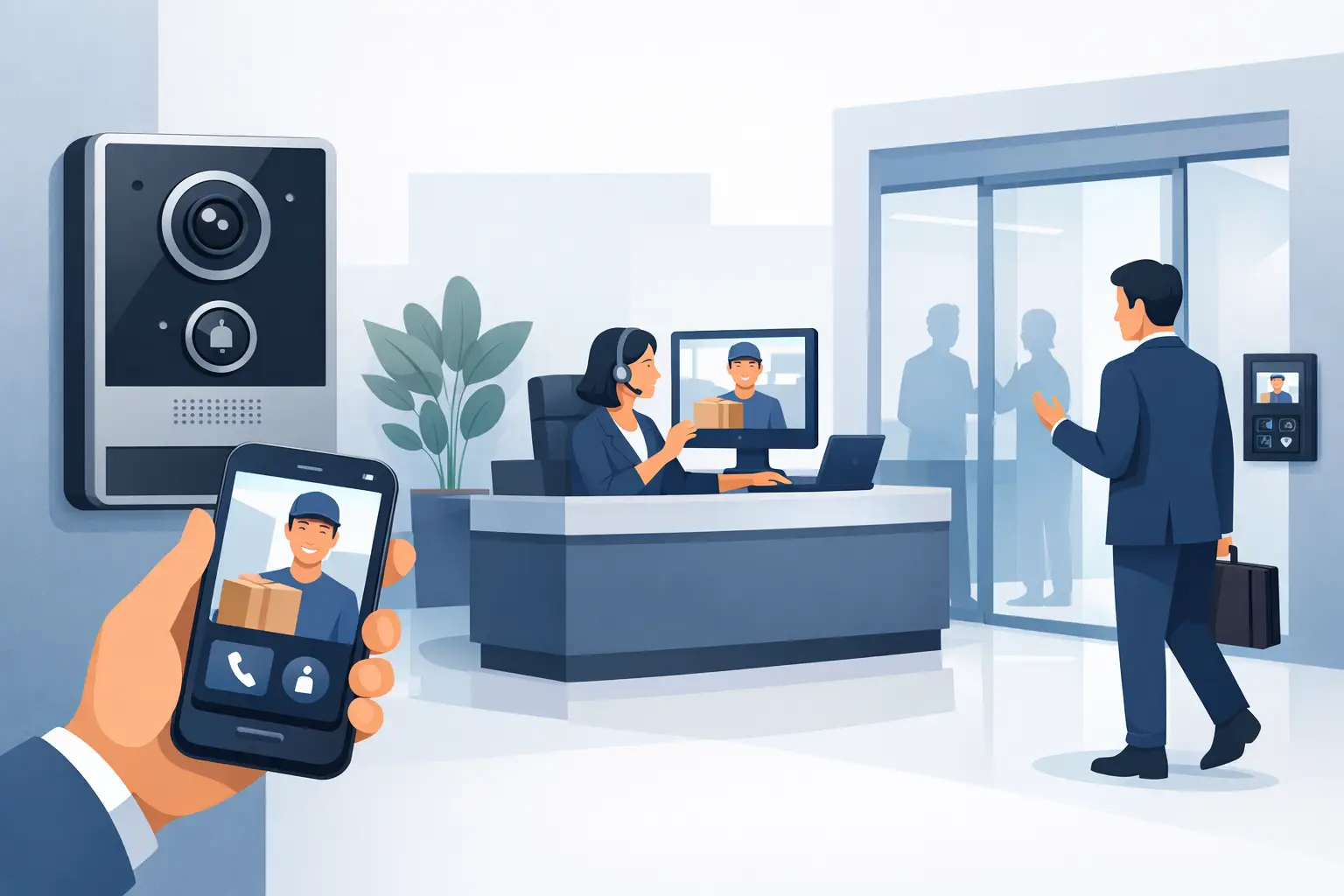
The front desk is often expected to do three jobs at once: welcome genuine visitors, keep staff safe and prevent unauthorised people from walking further into the building. Video door entry for office reception gives the person answering the door the information and control to make the right decision before access is granted.
For a small office, managed building or multi-occupancy site, that control should not depend on a key being passed around, an unlocked entrance or staff having to leave their desk to investigate a buzzer. A properly specified IP door entry system lets reception see and speak to the caller, release the door where appropriate and maintain a more professional, secure entrance.
Why reception door entry needs more than a buzzer
A standard audio intercom tells staff that someone is at the door. It does not show whether that person is the expected delivery driver, a contractor who has arrived at the wrong time, or someone attempting to gain entry by following a genuine visitor. Video changes the quality of the decision.
A clear camera view allows reception staff to verify who they are dealing with before opening the door. This matters when the desk is busy, when staff are unfamiliar with every visitor, or when the entrance is shared by several businesses. It also provides reassurance for employees working early, late or alone.
The value is not only about stopping intrusion. A controlled entrance creates a calmer arrival process. Visitors know where to call, staff can respond without abandoning reception, and authorised users can enter using their assigned credential rather than waiting to be admitted. That is particularly useful in offices where the reception desk is not staffed continuously.
What a video door entry system should do
The right system is based on how people actually use the building. For most offices, the essential functions are straightforward: see the caller, speak to them, decide whether to release the door and give regular users a reliable way to enter without calling reception.
Dahua IP video door entry systems are well suited to this requirement. An external door station can provide video calling and access credentials through a keypad, card or fob. Inside, a POE-connected 7-inch Android monitor gives reception or management a clear, simple point of control. Because Power over Ethernet carries power and data through suitable network cabling, installation can be neater and more dependable than relying on separate local power arrangements at every device.
For many sites, the door entry monitor becomes the practical control point for the entrance. Staff can answer a call, view the visitor and release the lock from one screen. The system can also be designed with additional indoor monitors where responsibility is shared between reception, a manager’s office or another department.
The precise feature set depends on the site. A single-office entrance has different needs from a building with several occupiers, multiple entrance doors or a separate delivery point. A free site survey is the right time to identify those differences before equipment is chosen.
Credentials should match the people using the building
Keys are familiar, but they offer little control once they have been copied, lost or not returned by a former employee. Electronic credentials make day-to-day access easier to manage. A fob or card can be issued to staff, while a keypad code may suit regular contractors or teams that need access at set times.
There are trade-offs. Shared codes are convenient but reduce accountability, because it is harder to identify who used them. Individual cards or fobs offer better control, but they need an organised process for issuing, replacing and removing credentials. For a business handling sensitive information, valuable equipment or controlled stock, individual credentials are generally the stronger choice.
A professional installer should ask who needs access, which doors need control and what should happen when someone leaves the business. The aim is not to add features for their own sake. It is to avoid a system that is either too basic to protect the entrance or unnecessarily complicated for staff to use.
Planning video door entry for office reception
The door station has to work in real conditions, not just look good on a specification sheet. Camera position, lighting, visitor approach routes and the type of door locking all affect the result.
Get the visitor view right
The camera needs a useful view of the caller’s face at the point where they press the call button. If it is mounted too high, angled towards strong daylight or positioned beside a reflective glass panel, image quality can suffer. A good survey considers the height of different users, whether people approach from the side and whether the entrance becomes poorly lit in winter afternoons.
Where low-light conditions are a concern, the wider CCTV design should also be considered. Smart illumination and colour night coverage can help provide clearer, actionable visibility around approach routes and entrance areas when activity triggers attention. Door entry identifies the visitor at the threshold; CCTV can give a broader view of how they arrived and what is happening nearby.
This does not mean every office needs cameras covering every angle. It means the entrance should be assessed as part of the property rather than as an isolated door. A rear staff entrance, side gate or poorly lit car park route may present a greater risk than the reception door itself.
Specify the lock and fire safety correctly
A video door entry system can only control a door properly if the locking arrangement is suitable. The existing door, frame, closer, escape route and access requirements must all be checked. Some entrances may use an electric strike, while others need a magnetic lock or a different solution entirely.
Fire safety is central to this decision. People must be able to leave safely in an emergency, and the door configuration must work with the building’s wider fire arrangements. This is one reason a door entry installation should not be treated as a simple fit-and-forget purchase. Incorrect locking can create operational problems as well as a safety risk.
Network resilience also deserves attention. IP systems depend on correctly installed cabling and suitable network planning. POE is an efficient approach, but the switch capacity, cable routes and backup expectations should be agreed before installation. If reception cannot answer the entrance during a network issue, staff need to understand the fallback procedure.
How video door entry improves accountability
An office entrance is a point of decision. Without a defined process, people make quick assumptions: someone looks familiar, a delivery is expected, another employee must have arranged the visit. Those assumptions are where preventable security gaps appear.
With video door entry, staff have a consistent process. They can view the caller, ask who they are visiting and confirm the reason for access before opening the door. That is a practical defence against tailgating and social engineering attempts, where a person relies on politeness or urgency to gain entry.
The system also supports better visitor management, although it does not replace it. Businesses that receive contractors, clients or delivery drivers regularly may still need a sign-in process, visitor badges or an escort policy. Door entry is the first control point, not the only one.
For managed office buildings, accountability is even more valuable. Separate occupiers may need their own calling arrangements, while building management needs dependable access for maintenance and emergency attendance. A scalable IP system can be planned around those responsibilities rather than forcing every user into one shared method of entry.
Choosing an installer, not just a product
The monitor and door station are the visible parts of the system, but the quality of the installation determines whether they remain easy to use. Cable routes, door hardware, network configuration, image angles and staff handover all matter. A low initial price can become expensive if the system has poor coverage, unreliable unlocking or no support when a credential needs changing.
Ask whether the installer will survey the property, explain why the proposed equipment suits the site and provide a clear quotation. They should also discuss after-sales support, because office access needs change. Staff join and leave, departments move, and a second entrance may later need to be brought under control.
NRI Security takes a consultative approach to these decisions, with a free site survey and no-obligation quotation before recommending a suitable system. The focus should always be on the level of protection and usability your office needs, not on pushing unnecessary equipment into the proposal.
A well-planned video door entry system gives reception a simple instruction every time the bell rings: see who is there, speak to them and stay in control of the door. That small change can make the whole office feel more secure, more organised and better prepared for the unexpected.

CCTV Installer Chorley: What Good Looks Like
Choosing a cctv installer chorley? Learn what a proper survey covers, the kit that matters, and how to avoid poor night footage and weak deterrence.

Case Study: Door Entry for Apartment Blocks
A practical case study of door entry in apartments, covering access control, IP video, resident usability and installation choices that protect residents.

CCTV Maintenance Contract for Small Businesses
A CCTV maintenance contract for small businesses keeps cameras, recording and remote access reliable, compliant and ready when incidents happen.

Smart Lighting CCTV That Actually Helps at Night
Security cameras with smart lighting improve night footage, deter intruders, and cut false alerts. Learn what matters, placement tips, and trade-offs.

Can Neighbours Complain About My CCTV UK?
Can neighbours complain about my CCTV UK? Learn when complaints are valid, what the law says, and how to position cameras properly.

How to Plan an Apartment Intercom Upgrade Safely
Learn how to plan apartment intercom upgrade work with clear entry rules, suitable IP equipment, resident communication and reliable ongoing support too.

Why Security Consultation Before Installation Matters
Security consultation before installation helps you choose the right CCTV, alarms and access control for proper coverage, compliance and value.

Intrusion Line Triggered CCTV: A Practical Guide
Intrusion line triggered cctv captures the moment someone crosses a boundary, improving night footage, alerts and evidence without constant false alarms.

Latest Perimeter Detection Technology Explained
See how latest perimeter detection technology combines smart CCTV, lighting and intrusion alerts to protect homes and business premises around the clock.

Colour Night Vision CCTV Cameras: Worth It?
Colour night vision CCTV cameras capture clearer detail after dark, helping you identify people and vehicles. Learn how they work and where they fit.

Smart Home Security Installation Done Right
Smart home security installation works best when cameras, alarms and entry systems are designed properly, fitted well and supported after handover.