


Compare wired vs wireless alarm systems for homes and businesses. See the real trade-offs in reliability, installation, upkeep and cost.
Video Doorbell vs Door Entry for Your Property
A parcel arrives while you are out. A visitor calls at a family home. A contractor needs access to an office reception. These situations may look similar, but the right response is not always the same. The choice between a video doorbell vs door entry system comes down to more than seeing who is outside. It is about how much control the property needs, who uses it and what should happen after a visitor presses the call button.
A video doorbell is often a sensible first step for a single home entrance. A professionally specified video door entry system is usually the stronger choice where controlled access, multiple users or a communal entrance are involved. Both can provide live video and two-way speech, but they are designed to solve different problems.
What a video doorbell is designed to do
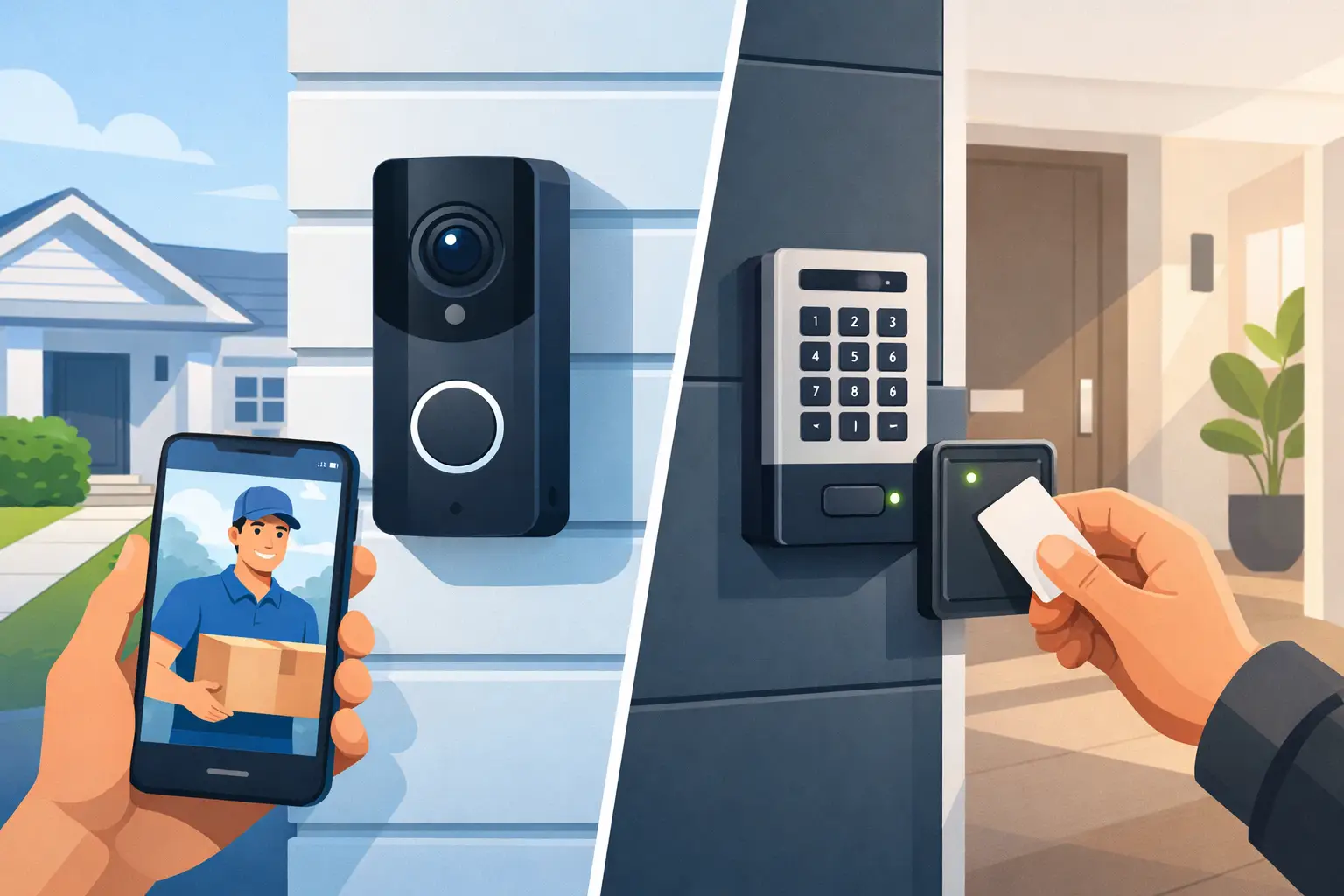
A video doorbell is a compact camera and call point fitted at a front door or gate. When somebody presses it, the owner receives an alert through an internal chime, a mobile app, or both. They can view the caller, speak to them and, where an electric lock or gate release has been integrated, grant access remotely.
For many homeowners, that is exactly the reassurance they need. You can check whether a caller is genuine before opening the door, speak to delivery drivers when away from home and keep a visible deterrent at the entrance. Some models also record motion-triggered clips, which can add useful context if someone approaches the property without ringing.
The attraction is simplicity. A video doorbell is normally intended for one household, one entrance and a small number of regular users. It can be a good fit for a terraced house, a bungalow or a property where the priority is knowing who is at the front door rather than managing access for several people.
That said, not all video doorbells offer the same level of reliability or coverage. Battery-powered units can be convenient, but require charging and may have limitations in very cold weather, busy locations or areas with weaker wireless signal. App notifications also depend on stable internet and sensible configuration. A camera placed too high, too low or facing direct glare may record a face poorly when it matters most.
Video doorbell vs door entry: the key difference
The central difference is access control. A video doorbell tells you someone is there and allows a conversation. A door entry system is built to manage who can enter through a controlled door, gate or communal entrance.
IP video door entry combines a camera call station with indoor monitors and electronic locking. When a visitor calls, the right resident, member of staff or administrator can see and speak to them before releasing the door. It can be configured for one property, but it comes into its own in buildings with multiple flats, offices, nurseries, managed developments and shared entrances.
A properly designed system can also give authorised users ways to enter without making a call. Depending on the installation, this may include a keypad code, proximity card or fob. That gives a facilities manager or landlord a clear way to issue, replace and withdraw access. It is far more manageable than relying on copied keys whose location may be unknown.
For this reason, door entry is not simply a more expensive video doorbell. It is infrastructure for the entrance. The cable routes, lock type, power provision, monitor locations and network connection all need consideration before equipment is chosen.
When a video doorbell is the right fit
Choose a video doorbell when the property has a straightforward single entrance and the main aim is visitor awareness. It suits homeowners who want to answer the door from the sofa, work, or while away for the day. It can also work well at a side gate, provided the gate and its surroundings are suitable for the chosen equipment.
It is especially useful where there is no need to issue credentials to staff, residents or contractors. If only household members need to enter, and the door remains conventionally locked, a video doorbell delivers a clear improvement in visibility without introducing a larger access control system.
A wired installation is generally worth considering where practical. It avoids the regular task of removing and charging a battery, and professional fitting helps ensure the call point has stable power, usable Wi-Fi coverage and a camera angle that identifies visitors rather than just the top of their head.
A video doorbell should not be treated as a replacement for security lighting, CCTV or a properly secured door. It is one layer at the entrance. Where a driveway, side passage or rear boundary needs monitoring, a wider CCTV design with appropriate camera placement and smart illumination may offer better protection.
When door entry is the stronger choice
Door entry is usually the correct route when several people need controlled access or the entrance serves more than one occupier. In a block of flats, residents need calls directed to their own home, while visitors must not be able to enter merely because somebody else has opened the communal door. In an office, reception staff may need to verify callers, while employees use fobs or cards throughout the day.
Nurseries and similar regulated environments have an even clearer need for accountability. Staff, parents, contractors and visitors should not all have the same route through the door. A video door entry system supports a controlled reception process, helping staff verify who is requesting entry before releasing a lock.
Dahua IP video door entry systems are one example of the type of equipment suitable for these environments. POE-connected 7-inch Android monitors can provide a dependable fixed point for answering calls inside the building, rather than relying solely on a personal mobile phone. Keypad, card and fob options can then be matched to the way the site operates.
This does not mean every business needs a complex system. A small office with one staff entrance may only require a single call station, one monitor and a well-chosen release method. The point is to design for the real routine at the door: early arrivals, deliveries, visitors, staff turnover and out-of-hours access.
Fixed monitors versus mobile apps
Mobile access is convenient, particularly for homeowners and managers who are often off site. But a fixed monitor has practical advantages. It remains in place, is visible to anyone responsible for answering the entrance and does not depend on an individual keeping their phone charged, connected or available.
For a family home, app-based answering may be entirely sufficient. For a communal building, office reception or nursery, a monitor at the right location often provides better day-to-day accountability. Many installations can use both, allowing the system to suit the building rather than forcing users into one method.
Credentials, keys and daily control
Traditional keys are familiar, but they are difficult to control once issued. If a fob is lost, a card is not returned, or a staff member leaves, access can be managed more clearly through an electronic system than by changing every physical lock.
A keypad can be useful for temporary access, but codes should be changed when circumstances change. Cards and fobs are often convenient for regular users. The most suitable method depends on the number of users, the risk level and whether the property needs a record of access activity. A survey should establish these requirements before an installer recommends equipment.
Installation details that affect reliability
The best door system is the one that works every time a visitor arrives. That depends on the installation as much as the product. A door or gate release must be compatible with the existing door, frame and locking arrangement. Cable routes need protecting, exterior call stations need appropriate weather resistance, and the camera must cope with changing daylight and low-light conditions.
For IP door entry, POE can simplify the installation by carrying power and data through one network cable. This can provide a tidy, stable foundation for call stations and monitors, particularly in commercial or multi-occupancy settings. It also makes future servicing and fault-finding more straightforward than an improvised mix of adapters, wireless extenders and consumer equipment.
Privacy should also be considered. Cameras should be positioned to cover the entrance purposefully, not to intrude on neighbours’ private areas. For businesses, the people responsible for the system should understand who can view footage, how notifications are managed and how visitor calls are handled outside normal hours.
Make the decision around the entrance, not the gadget
Start with three practical questions. How many entrances need to be controlled? How many people need authorised access? And what happens if nobody is available to answer a call? The answers usually make the choice clearer.
A video doorbell is a strong option for a straightforward home entrance where visibility and remote conversation are the priorities. Door entry is the better long-term investment where the building needs controlled release, multiple users, indoor answering points or organised credential management.
There is also room for a combined approach. A home may use video door entry at a main gate and CCTV to cover the approach. An office may use door entry at reception, fobs at a staff door and monitored CCTV at the perimeter. Each part has a defined job, rather than one device being expected to do everything.
Before committing, arrange a site survey that looks at the actual door, users, cable routes and security risks. NRI Security can advise on the right-fit system and provide a no-obligation quotation, so the result is practical for the property now and dependable as your needs change.

Is CCTV Legal at Home in the UK?
Is CCTV legal at home UK? Yes, usually – but camera position, audio, neighbours and recorded footage all affect whether your setup stays lawful.

Free CCTV Site Survey: What You Really Get
A free cctv site survey shows what cameras you need, where they should go, and what it will cost. Avoid blind spots and overspend.

CCTV Installer Chorley: What Good Looks Like
Choosing a cctv installer chorley? Learn what a proper survey covers, the kit that matters, and how to avoid poor night footage and weak deterrence.

8 Best Ways to Deter Trespassers at Home
Learn the best ways to deter trespassers with practical CCTV, lighting, access control and boundary advice for homes and businesses across the UK today.

Ajax alarm app review for homes and businesses
Ajax alarm app review for UK homes and businesses. See how it handles alerts, user control, automation and daily use before you buy.

How to Reduce Blind Spots in CCTV
Learn how to reduce blind spots CCTV systems miss with better camera placement, lens choice, lighting and professional site surveys.

Business Access Control Guide for Safer Sites
A practical business access control guide for offices, flats and managed sites. Learn what to choose, how systems work and what really matters.

Best CCTV Camera Locations Around a House
Find the best CCTV camera locations around a house for stronger deterrence, clearer footage and practical coverage that protects key entry points.

Remote CCTV Monitoring Apps That Feel Reliable
Choosing a remote cctv monitoring app? Learn what matters: alerts, playback, privacy, user access, and setup for homes and small businesses.
Gate Intercom System for a Private Driveway
Choose a gate intercom system for private driveway access with clear video, reliable calling and professional installation advice for lasting control daily

CCTV Maintenance Checklist for Businesses
Use this CCTV maintenance checklist for businesses to test cameras, recordings, remote access and lighting, so your premises stay protected every day.